A B section belt with the stamping worn down to a smooth back is what most people bring to the counter. The useful answer is rarely a part number. It is three measurements taken in the right order: top width and thickness to confirm the section, then length, plus a note on which length basis the supplier quotes. Width and thickness narrow the search to one family of belts; length decides whether a belt from that family actually sits correctly in your pulleys.
Work in millimetres for width and thickness, and record length in both millimetres and inches if you can. In our experience the majority of wrong orders are not caused by a careless measurement but by a length that was measured as outside length and ordered as datum length. Those two numbers differ by enough to put you one or two sizes off.
The Three Dimensions That Define a V Belt
Every wrapped V belt is described by its section, which fixes the top width and the height of the trapezoid, and by its length. Once the section is known, the length search collapses to a single column in a catalogue or a single page in a cross reference guide.
Top width
Measure across the widest part of the belt with the belt lying flat and relaxed, not curved over your hand. A caliper is better than a tape measure here, because the difference between an A and a B section is only about 4 mm. Take three readings along the length and use the middle value; a belt that has been running hot can show a slightly swollen edge.
Thickness, or height
Measured from the top surface to the bottom surface at the centre line. This number separates a standard industrial section from a narrow section of similar width. A 13 mm wide belt could be an A section at 8 mm high or a narrow SPA section at 10 mm high, and those two are not interchangeable in the same groove.
Length
Length is where most of the confusion lives, and it is covered in detail further down. For now, note that a length can be quoted as outside length, datum length or inside length, and each of those is a different physical measurement on the same belt.
| Section |
Nominal top width |
Nominal thickness |
Common length basis |
| Z |
10 mm |
6 mm |
Inside length (Li) |
| A |
13 mm |
8 mm |
Outside or inside |
| B |
17 mm |
11 mm |
Outside length (La) |
| C |
22 mm |
14 mm |
Outside length (La) |
| D |
32 mm |
19 mm |
Outside length (La) |
| SPZ |
9.7 mm |
8 mm |
Datum length (Ld) |
| SPA |
12.7 mm |
10 mm |
Datum length (Ld) |
| SPB |
16.3 mm |
13 mm |
Datum length (Ld) |
| SPC |
22 mm |
18 mm |
Datum length (Ld) |
Nominal figures only. Actual width and height vary slightly between manufacturers, so a belt measuring 16.8 mm across the top is still an SPB and worth checking against the maker datasheet before you reject it.
How to Measure a Belt You Still Have
If the old belt survived the failure, it is the best reference you have. Work through these steps in order and write the numbers down rather than trying to remember them.
- Clean the belt. Oil, dust and rubber transfer hide the edges that define the true width.
- Lay it on a flat bench and let it relax for a minute. A belt that has been curled around a small pulley will read narrow at the ends.
- Measure the top width with a caliper at three points roughly 120 degrees apart, then record the average.
- Measure the thickness at the same three points.
- Mark a start line across the back with chalk or tape, stand the belt on edge against a wall, and roll it one full turn while marking the wall at the start and finish points. The distance between the marks is the outside length.
- Alternatively, cut the belt open, lay it flat and measure end to end. This is the most accurate method for a damaged belt that will not be reused.
Treat the result as a maximum. A worn belt that has run for a year or more typically reads 1 to 2 percent longer than its original length, and on a long B section that can be 20 mm or more. If the belt is clearly stretched, measure the drive instead of the belt.
Outside Length, Datum Length and Inside Length Are Not the Same Number
Three numbers are printed on V belt catalogues, and they refer to three different paths around the same belt. Outside length, often written La, is measured around the outer surface. Datum length, written Ld, is measured at the cord line inside the belt where it does not stretch or compress. Inside length, written Li, is measured around the inner surface.
The gaps are not small. On a classical B section, the difference between outside and inside length is commonly in the range of 30 to 40 mm, which is more than a full size step. Handing a supplier an inside length and asking for that number as an outside length will produce a belt that is visibly too short.
Regional convention makes this harder. Classical A, B, C and D belts in inch markets are usually ordered by outside length, while narrow SP sections and most metric markets work in datum length. Wrapped belts and raw edge cogged belts of the same nominal size can also differ slightly. When you have the choice, quote the section and both the number and the basis, for example B section, 1905 mm outside length. Any competent supplier can work from that.
When the Belt Is Gone: Measure the Drive Instead
No belt, no markings, and a machine that needs to run. In that case the pulley geometry gives you the length. You need three values: the centre distance between the two shaft centres, and the outside diameter of each pulley.
The standard approximation for pitch length is: L equals 2C plus 3.14 times the sum of D1 and D2 divided by 2, plus the square of the difference between D2 and D1 divided by 4C. Here C is the centre distance and D1 and D2 are the pulley diameters.
- Measure centre distance between shaft centres, not between pulley edges.
- Measure pulley outside diameter across the face, and subtract roughly twice the groove depth if you need pitch diameter.
- Add a tensioning allowance. Most drives need 2 to 4 percent of length available for take up, so a motor on slotted rails should not be at the end of its travel with a new belt fitted.
While the belt is off, check the grooves. A groove width gauge or a simple profile check with a new belt section will show whether the flanks are worn concave. A worn groove lets a new belt sit too low, so it slips even at correct tension, and no amount of length calculation will fix that. Groove angle is usually 34 or 38 degrees depending on pulley diameter, and mixing the two on one drive wears belts quickly.
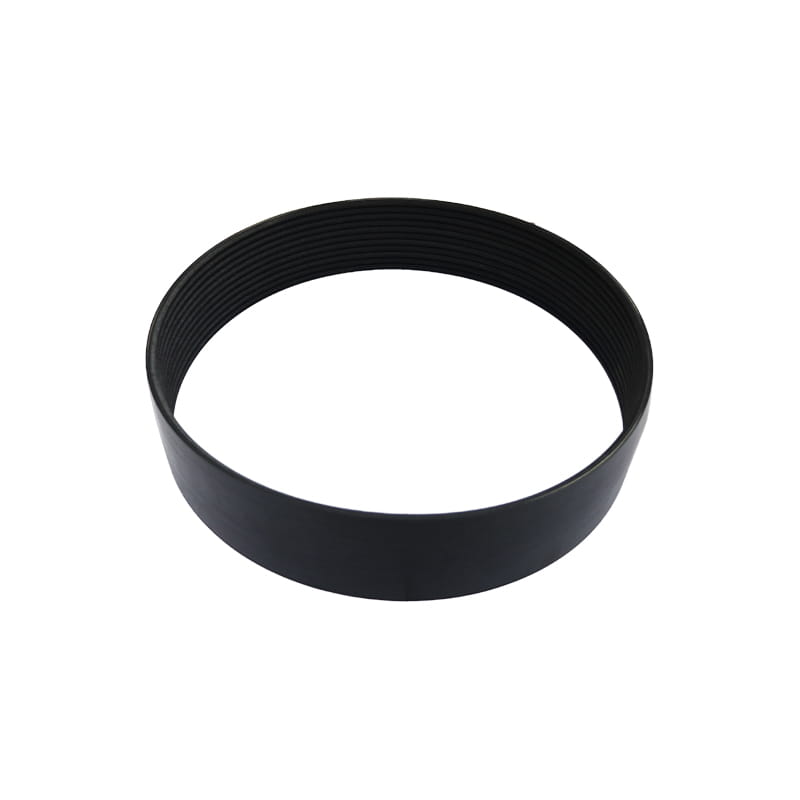 Rubber Wide-Angle Transmission Belt for Industrial DrivesA 60° wedge belt with PU, CR, or EPDM options and 3M–11M profiles, suited when checking belt and pulley wear together.View Product →
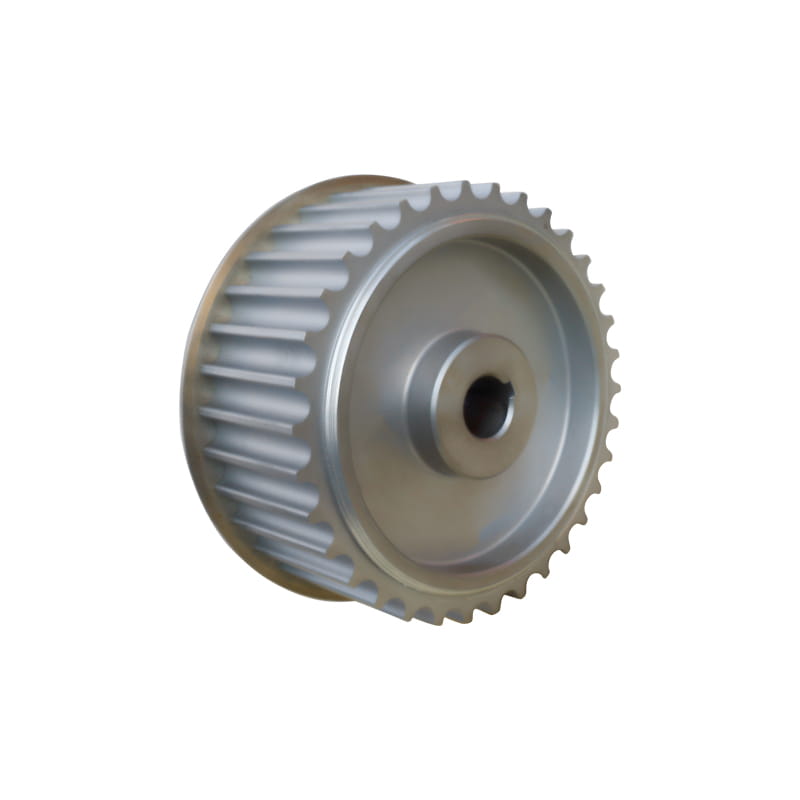
If the pulley itself is the worn part, replacing it together with the belt is usually cheaper than replacing belts twice a season.
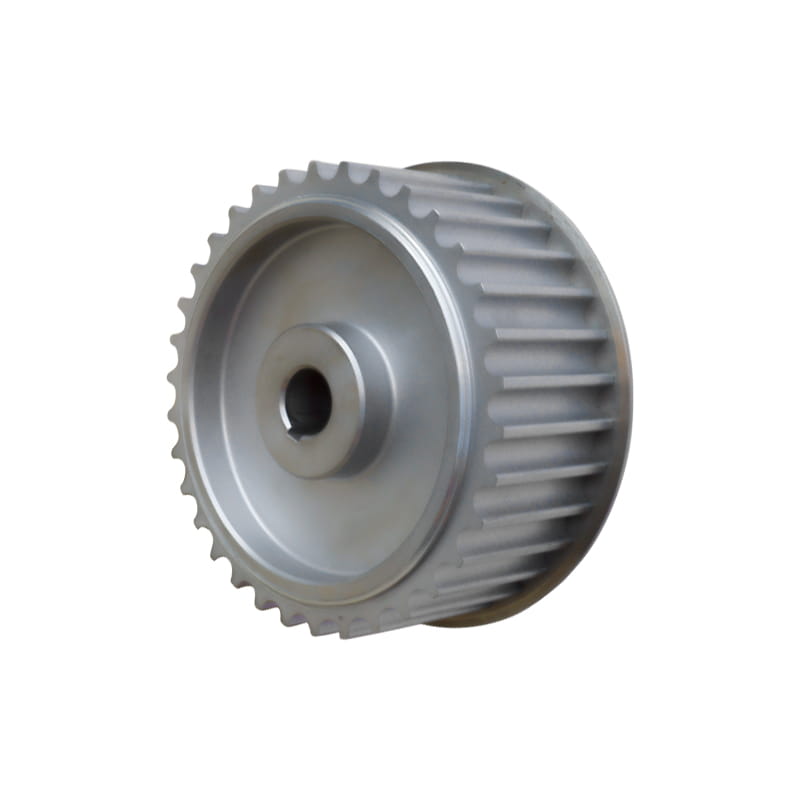 Customizable Synchronous Pulley for Belt-Driven SystemsA synchronous pulley with steel, aluminum, stainless, cast iron, or nylon options; customizable pitch, teeth, bore, and hub dimensions for driven systems.View Product →
Reading the Number Stamped on the Belt
Most belts still carry a code, and it usually contains everything you need once you know the pattern.
- B75 means a B section belt with a 75 inch outside length, roughly 1905 mm.
- A42 means an A section belt with a 42 inch outside length.
- SPB 2360 means an SPB section belt with a 2360 mm datum length.
- 3V 560 and 5V 1400 are inch series narrow sections, quoted by pitch length in tenths of an inch, so 560 is a 56.0 inch pitch length.
Where a code ends in Li or Ld, that suffix is not decoration. It tells you which measurement the number refers to, and it should be copied exactly when you place an order.
Five Mistakes That Lead to a Second Order
- Mixing length bases. An inside length sent as an outside length is the single most common error we see.
- Measuring a stretched belt and trusting it. Used belts read long, so a like for like replacement arrives loose.
- Measuring width at a swollen or frayed point instead of the average of three readings.
- Using a soft tape measure around a curved belt. The tape follows the arc and reads short.
- Reordering by machine model alone. Manufacturers change pulley sizes during a production run, so the same machine name can carry two different belt lengths.
Regular inspection and correct tensioning reduce how often you have to go through this process at all; our notes on maintenance and use of industrial belts cover the tension and alignment checks that keep a drive stable between replacements.
What to Write Down Before You Order
A complete request takes two minutes to prepare and removes almost all of the back and forth with a supplier.
- Section, confirmed by top width and thickness.
- Length value, with the basis stated as outside, datum or inside.
- Quantity, and whether the drive uses a matched set. Belts running in parallel on the same drive should come from the same production batch.
- Machine make and model, plus the original part number if it is legible.
- Pulley diameters and centre distance, in case the length needs to be recalculated.
- Operating conditions: temperature, oil exposure, dust, and whether the belt runs on a back idler.
Those last two lines matter more than they look. A drive running above 60 degrees C, or one exposed to oil mist, may need a different compound rather than a different size, and specifying only the dimensions will get you the right shape in the wrong material. Measure accurately, state the basis, and describe the environment. That combination is what turns a measurement into a belt that lasts its full service interval.



 中文简体