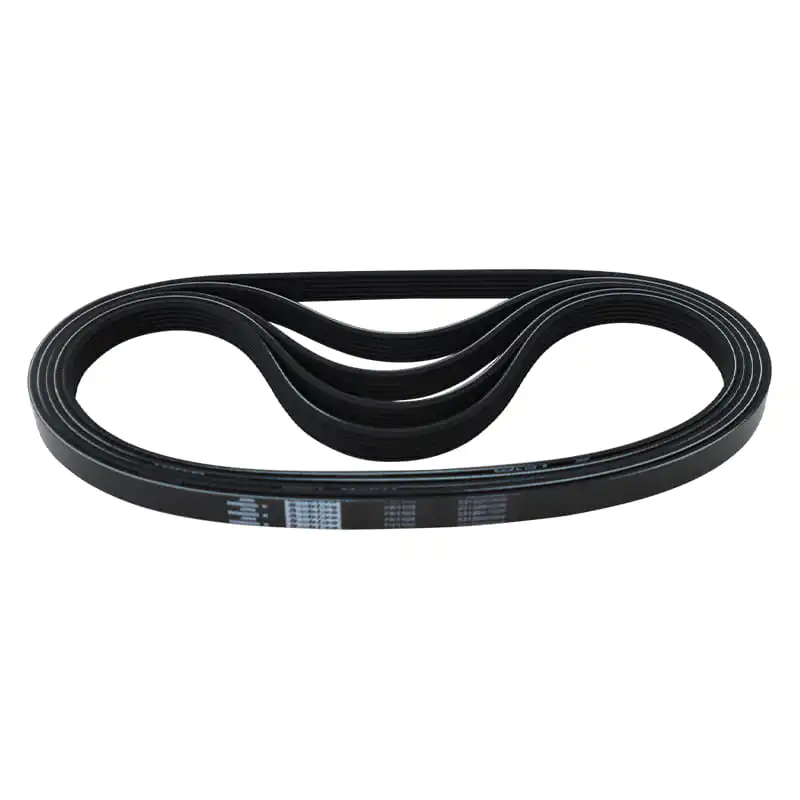
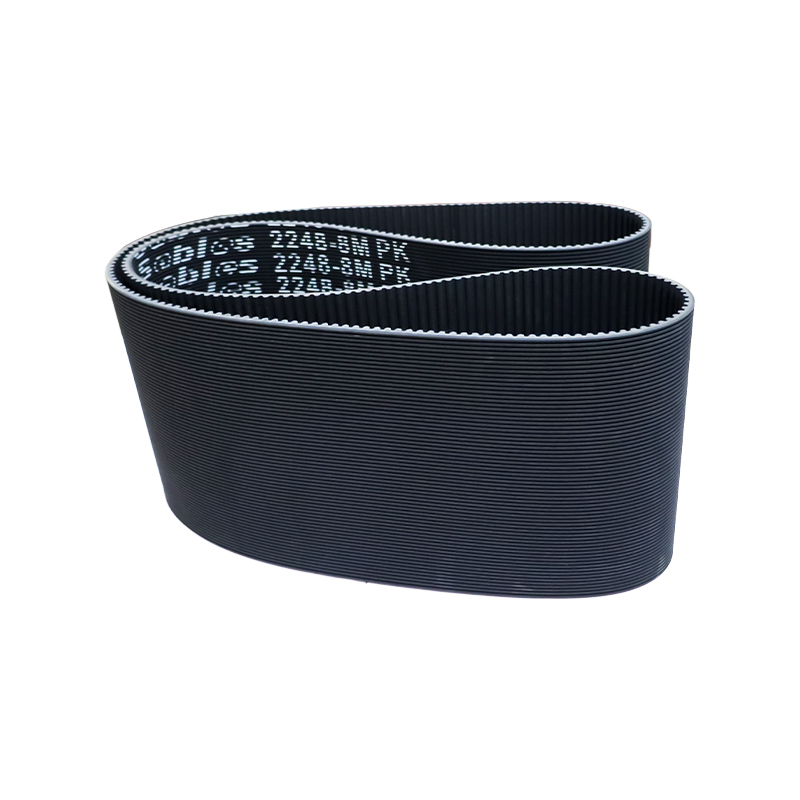
Your packaging line stops in the middle of a production shift. The rubber timing belt that drives the rotary cutter shows cracks on the back surface, and the machine no longer keeps registration. If the belt is marked HTD 720-8M, you need a replacement that matches the pitch length, tooth profile, and width before you can resume normal output. This guide explains what the designation means, where the belt is used, and what to check when you order a replacement or design a new drive.
What Does HTD 720-8M Mean?
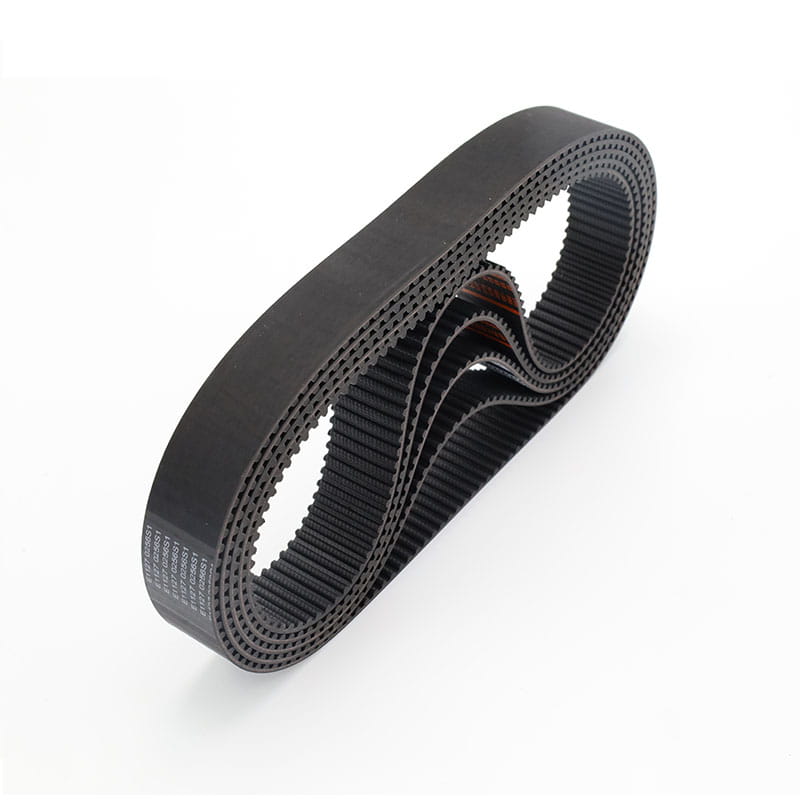
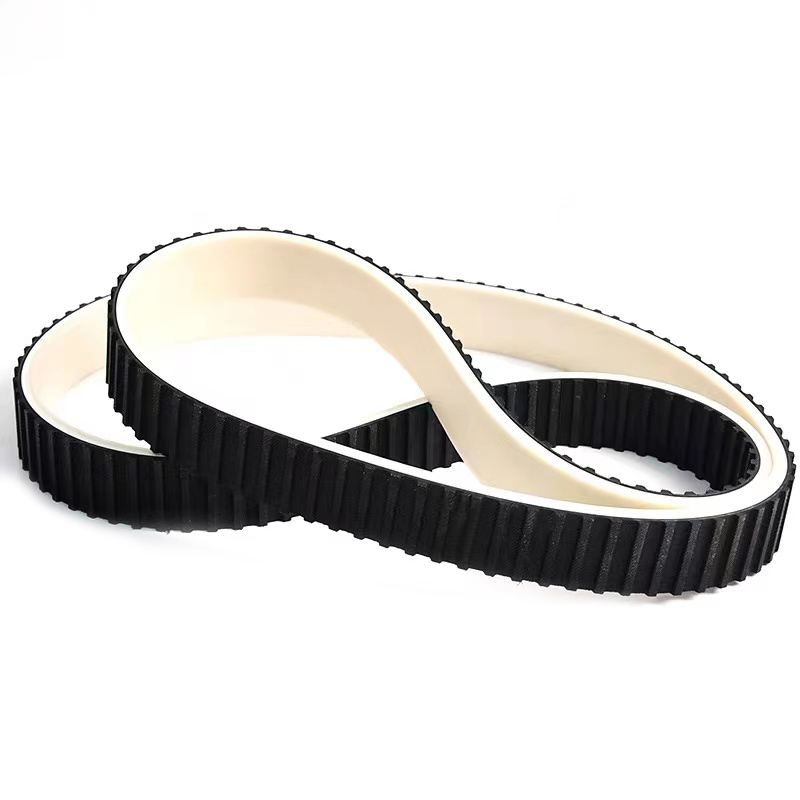
The designation HTD 720-8M is not arbitrary. HTD stands for High Torque Drive, which describes a curvilinear tooth profile developed for heavy-duty synchronous transmission. The number 720 is the pitch length in millimeters, measured along the pitch line of the belt. The 8M part indicates an 8 mm pitch, meaning the distance from one tooth center to the next tooth center is exactly 8 mm. Dividing the pitch length by the pitch gives the number of teeth: 720 divided by 8 equals 90 teeth. So an HTD 720-8M belt is a 90-tooth rubber synchronous belt with a rounded tooth shape designed to transmit higher torque than traditional trapezoidal belts.
Reference dimensions for a standard HTD 720-8M rubber timing belt
Parameter
Typical value
Notes
Pitch length
720 mm
Measured along the pitch line
Pitch
8 mm
Distance between tooth centers
Number of teeth
90
720 mm divided by 8 mm
Tooth profile
HTD curvilinear
Deep rounded tooth for high torque
Common widths
15, 20, 25, 30, 40, 50 mm
Width depends on drive design
Common tension member
Fiberglass cord
Low elongation under load
Backing material
Neoprene rubber
Wear resistant and oil tolerant
Figure 1: Typical power capacity of HTD 720-8M at different widths.
Figure 1 compares the typical power capacity of an HTD 720-8M belt at different widths, based on a speed of about 1450 rpm. A 15 mm wide belt transfers roughly 3.2 kW, which is enough for light auxiliary drives. The capacity rises to 4.6 kW at 20 mm and 6.1 kW at 25 mm, so a wider belt becomes necessary as the motor power increases. At 40 mm the belt can handle about 10.5 kW, and the 50 mm width reaches about 13.4 kW. The relationship is close to linear because the tensile cord area grows with the width. This chart helps you decide whether the existing drive has enough margin or a wider belt is required.
Why the HTD Tooth Profile Matters
HTD tooth profiles use a rounded, curvilinear form that distributes stress more evenly across the tooth flank. Trapezoidal belts such as MXL, XL, and L have straight-sided teeth and lower load capacity per unit of width. The AT profile also uses a curved shape, but with a different pressure angle and is common in European drives. For the same 8 mm pitch, an HTD belt can usually handle higher torque and operates with less backlash. If you are converting an existing drive, the tooth profile must match the pulley, because a curvilinear HTD tooth will not seat correctly in a trapezoidal groove. You can read a more detailed comparison of industrial synchronous belt tooth types if you are choosing between profiles.
Figure 2: Comparison of tooth profiles on five selection criteria.
Figure 2 compares the HTD profile with the AT profile and the traditional trapezoidal profile on five selection criteria. The HTD profile scores highest on load capacity and backlash resistance because of the rounded tooth flank and deep root. The AT profile is close in load capacity and position accuracy, but it is slightly weaker in noise control. The trapezoidal profile remains attractive when cost is the priority, and it is still simple to source for light-duty equipment. In every other criterion, the curvilinear HTD shape gives a more balanced overall result. If your machine needs quiet running and reliable torque at the same time, the HTD 720-8M is the safer choice.
Typical Applications for the HTD 720-8M
Because the belt is compact and precise, it appears in printing presses, packaging machines, textile equipment, photovoltaic module handling lines, and woodworking sanders. In printing, registration accuracy depends on the belt maintaining a constant relationship between the drive pulley and the print cylinder. In packaging, the 720 mm pitch length suits machines with moderate center distances, such as cartoners and case sealers. In photovoltaic lines, the belt moves glass and wafers with controlled acceleration. The width selected should match the load: a 20 mm belt suits lighter auxiliary drives, while 40 mm and 50 mm widths handle main drives with higher torque.
Figure 3: Typical service life of HTD 720-8M in five machine groups.
Figure 3 presents typical service-life values for an HTD 720-8M belt in five machine groups. Packaging machines reach about 15,000 hours because the loads are steady and the environment is clean. Photovoltaic production lines show about 16,000 hours when the belt runs in a temperature-controlled clean room. Printing presses stop near 12,000 hours because of variable ink loads and frequent start-stop cycles. Textile machines show about 11,000 hours due to higher ambient dust and humidity. Woodworking sanding machines have the shortest life, around 9,000 hours, because abrasive dust attacks the belt backing. These values are reference figures rather than guarantees, but they help you plan maintenance intervals.
Installation, Tensioning, and Life Expectancy
Even a correctly sized HTD 720-8M belt will fail quickly if it is over-tensioned, under-tensioned, or misaligned. The belt should seat in the pulley grooves without forcing, and the center distance should be adjustable to set the correct tension. Use a tension gauge and follow the value recommended by the drive designer; for a rubber synchronous belt, the deflection method is common. Under-tensioned belts skip teeth under shock loads, while over-tensioning shortens bearing life and can stretch the cord. Alignment of the two pulleys should be kept parallel, and a common rule is to hold shaft parallelism within 0.3 mm per 100 mm of pulley face width. Following proper installation practices for rubber synchronous belts reduces the risk of premature failure.
Figure 4: Tension retention of HTD 720-8M during 24 months of service.
Figure 4 shows how belt tension changes over 24 months under two different conditions. The upper line represents a correctly tensioned drive that loses tension slowly from 100 percent to about 82 percent. The lower line represents a drive that was initially set too loose and drops from 85 percent to about 61 percent. The gap between the two lines becomes wider with time, which explains why many premature failures happen in the second year of service. A belt running below the recommended tension can skip teeth during acceleration and cause registration errors. Checking tension every three months and making small corrections keeps the drive close to the upper line. This is the simplest way to extend the life of an HTD 720-8M belt.
Matching Pulley and Belt Width
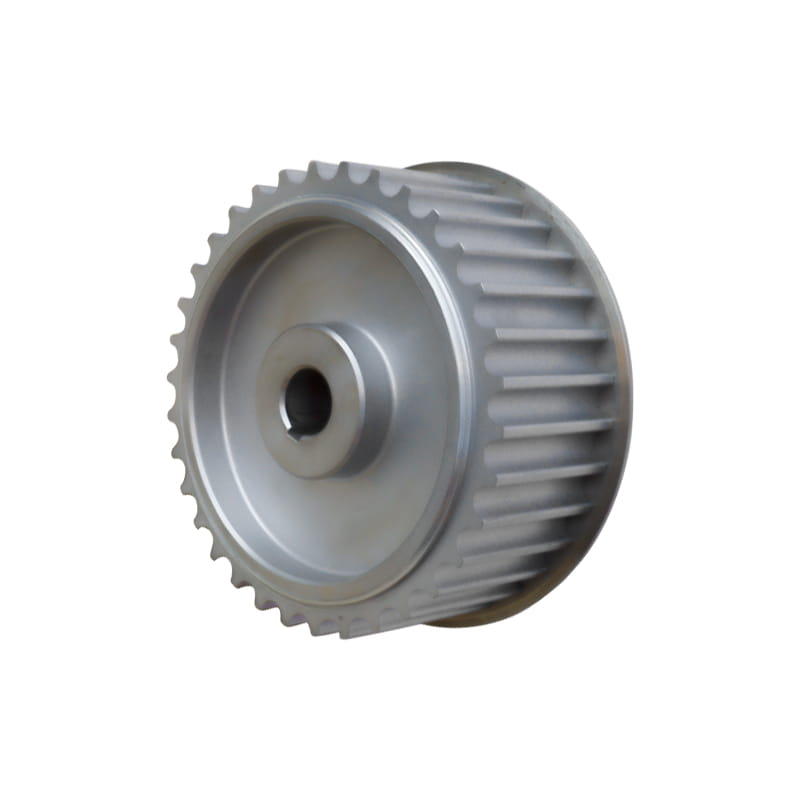
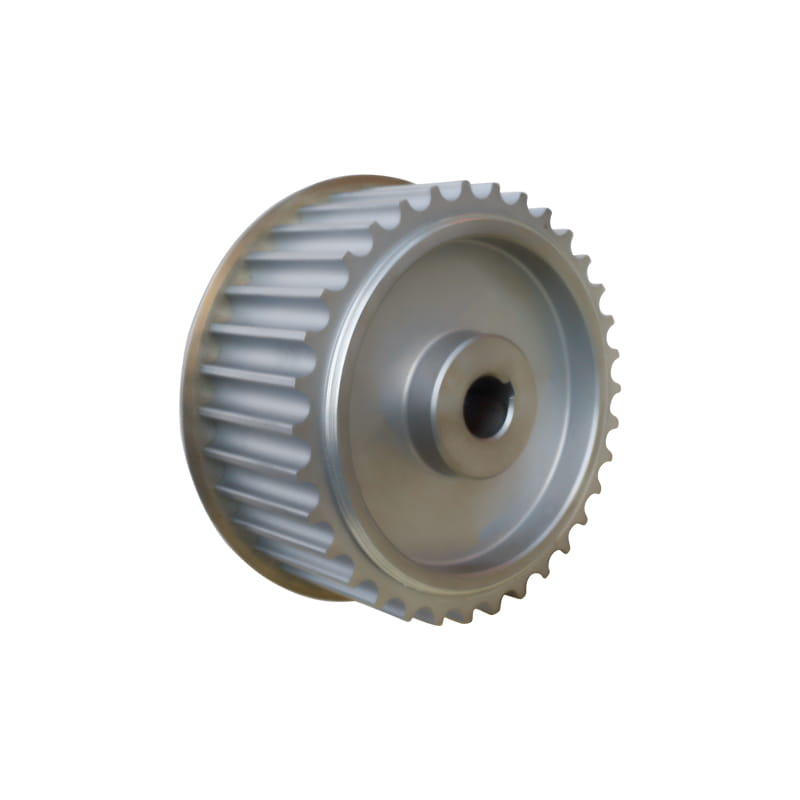
The pulley is as important as the belt. An HTD 720-8M belt must run on pulleys that use the same 8 mm HTD tooth profile and the same pitch diameter. If the pulley has worn teeth, the new belt will wear quickly or slip. The best practice is to replace the old belt with a new one on a pulley that is still in good condition, or replace both at the same time. Belt width also depends on the pulley flange width; a 25 mm belt needs a pulley that supports the full width without overhang. We offer matching synchronous pulleys manufactured to standard HTD dimensions, which simplifies the ordering process.
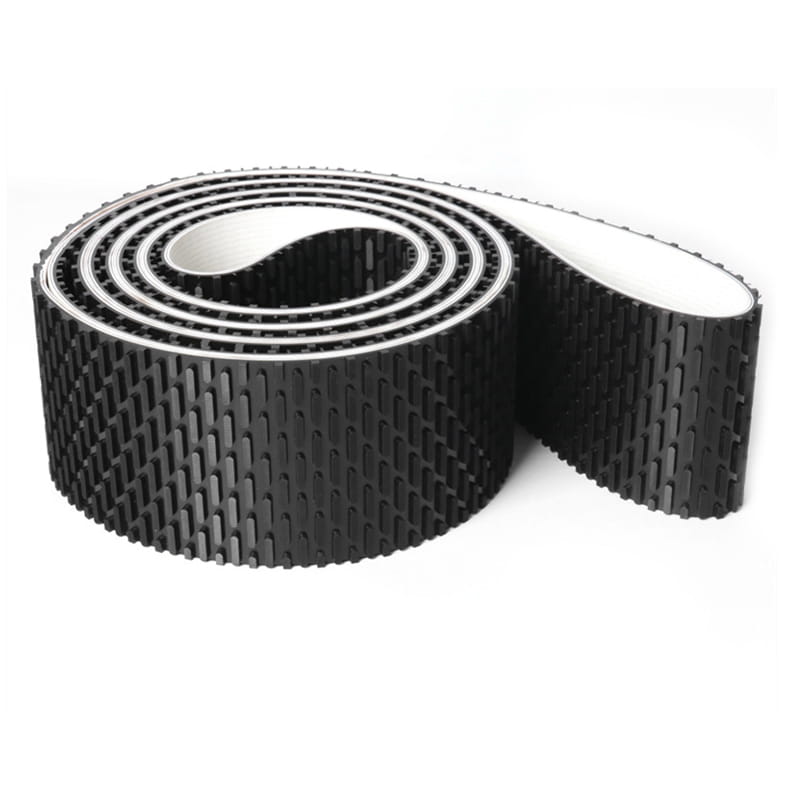
Before you place an order, confirm four things: the printed designation on the old belt, the number of teeth, the width, and the condition of the pulley. If the marking is worn, count 90 teeth on the old belt and measure the pitch length along the neutral line. Also check whether you need a standard rubber construction or a special surface, because some machines require oil resistance or static conductivity. A manufacturer with control over the rubber compound and curing process can provide a consistent product. Our standard range includes a rubber synchronous belt that matches the HTD 720-8M configuration and is suitable for most industrial drives.
Choosing the right HTD 720-8M belt comes down to matching dimensions, tooth profile, width, and construction to the actual working condition. A quality belt with the correct tension and aligned pulleys will run for years in most production environments. If you are unsure about a specific application, measure the old belt carefully and verify the pulley condition first. That small amount of upfront checking is the most effective way to avoid downtime and repeated replacement cost.
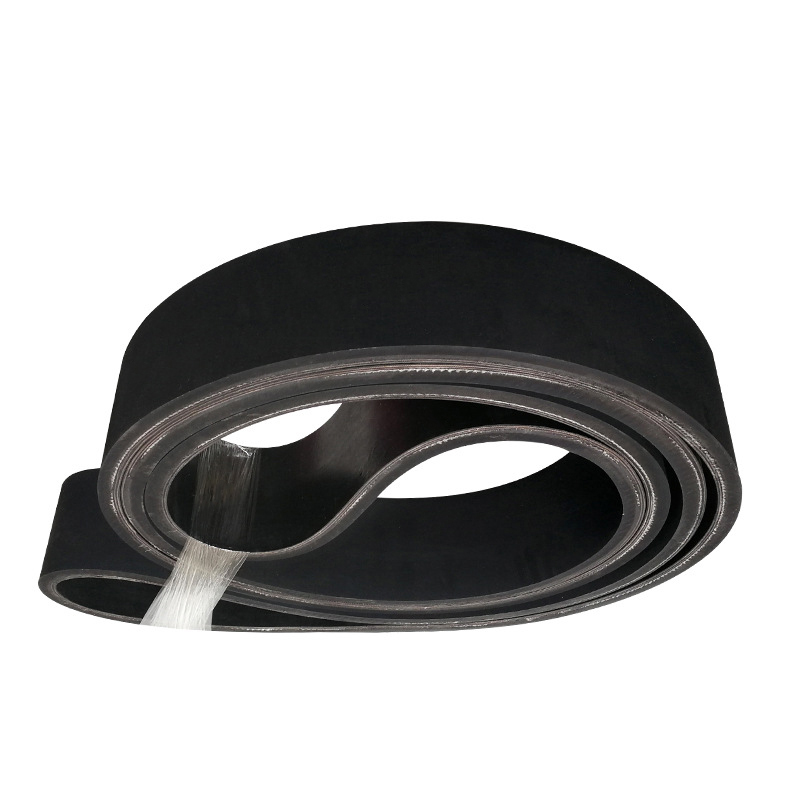
The conveyor belt is composed of surface adhesive, core, and layer glue. In addition, a layer of buffer cloth can be added to the use of high drop impact to make it more impact-resistant.
The surface adhesive
With natural rubber and synthetic rubber as raw materials and in order to enhance wear resistance, crack resistance, aging resistance, and other properties, the surface adhesive has various characteristics such as wear resistance, cutting resistance, heat resistance, flame resistance, cold resistance, acid and alkali resistance, oil resistance, static electricity resistance and so on. Cloth layer core
The cloth layer is composed of natural fiber or chemical fiber alone or a combination of the two, has the same quality after single-step treatment by a mature process, And has good adhesion with rubber. The adhesive layer
The adhesive layer is very important for the adhesive force between the layers of the core of the conveyor belt that is repeatedly flexed. Especially for high-tension conveyor belts, a layer of adhesive with less buckling stress and less fatigue due to internal stress must be used.
Specifications and models can be customized according to customer requirements, with a thickness ranging from 2.0 mm to 8.0 mm.
High-speed, smooth, and low-extension transmission and conveying systems, such as textile machinery, woodworking machinery, grinding machinery, ticket vending machines, vegetable cutting machines, etc. Characteristics: High speed and stability, high tensile strength, and low elongation.
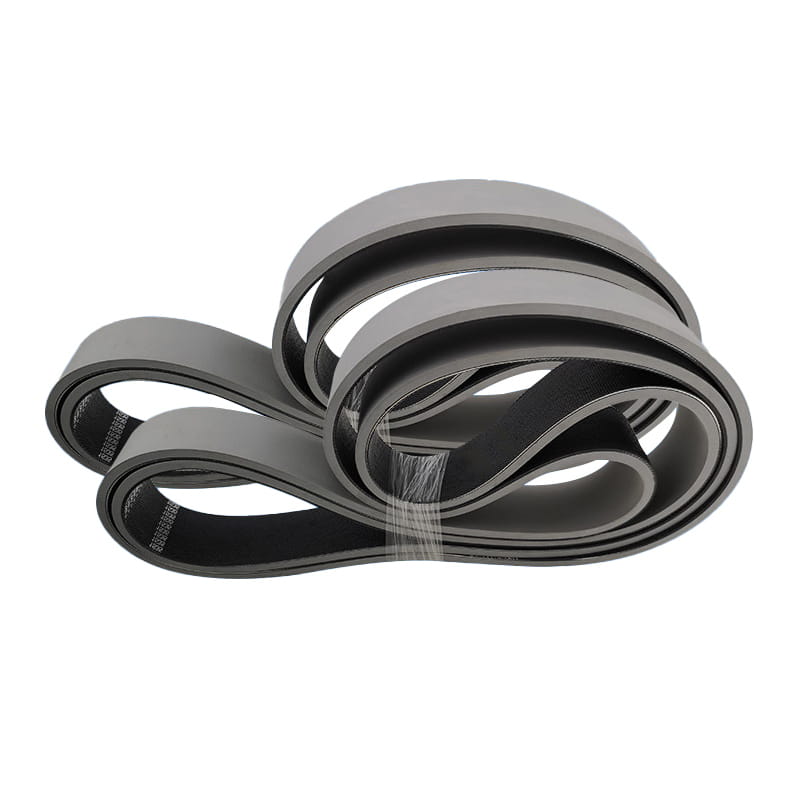
The seamless rubber band produced by woodworking machinery can be used for sanding, correcting, and trimming core materials, planing wood boards, laminated boards, plastic laminated boards, and other machines, and can help the surface to be perfectly machined and selected.
Its special technology lies in the manufacturing method and produces the required size jointless belt. We not only strictly control the quality, but also insist on using imported materials in order to make our sander belt have better performance.
All parts of thickness and strength are absolutely uniform.
It has a good linear operation.
High flexibility can be used for small wheel diameters.
It can maintain flatness and non-deformability under working pressure.
The friction coefficient between the bottom of the belt and the plate surface is very low.
Because the surface layer of the belt is covered with rubber, the adhesiveness is improved and the stability of the conveyor belt is improved.
Apply to each field of the synchronous-driven device system. Characteristics:
Ensure coordination with the belt, to enhance the accuracy and lifetime of the driven. According to customer requirements, customization optimum driven solution can divided into 45# steel, aluminium alloy, stainless steel, cast iron, nylon, etc, according to the material.
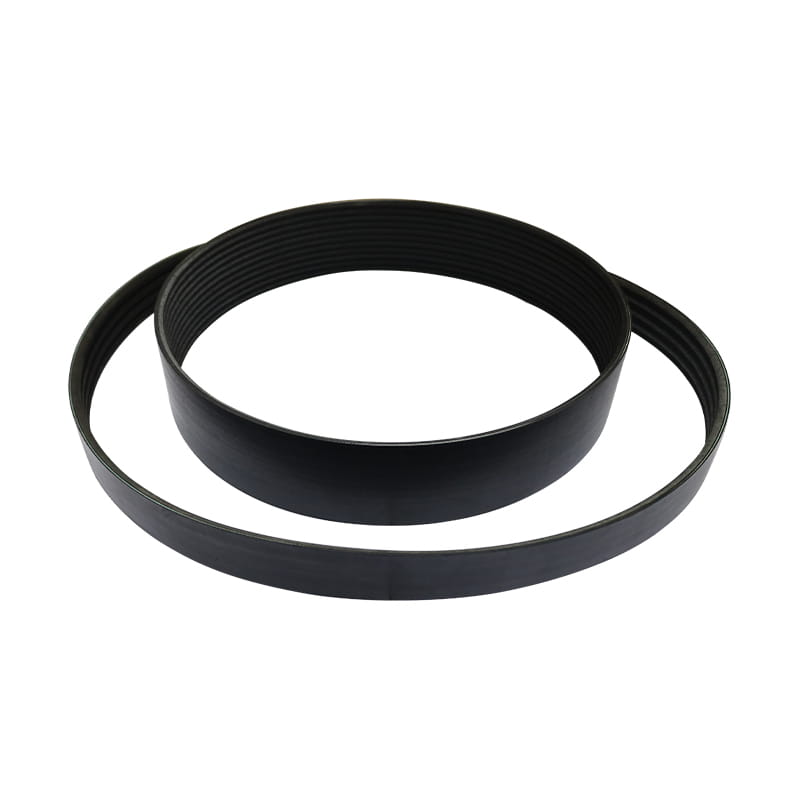
It is suitable for outdoor transmission equipment, transportation equipment, medical equipment, electric tools, household appliances, and sports equipment. Characteristics:
1. The transmission power of the ribbed belt is higher than that of an ordinary V-belt by 30 % when the space is the same.
2. The transmission system of the ribbed belt has a compact structure, and under the same transmission power, the space occupied by
the transmission device is 25 % smaller than that of the common V-belt.
3. The ribbed belt is thin and flexible and is suitable for transmission with a small pulley diameter and high-speed transmission, with belt
speed up to 40m/ s; Small vibration, less heat, and stable operation.
4. The ribbed belt is heat-resistant, oil-resistant, and wear-resistant, with small elongation and a long service life.



 中文简体
中文简体